Buying a yacht is one of the largest discretionary purchases a person will ever make, and it is one of the few made without a professional on the buyer's side of the table. A house purchase comes with lawyers, lenders, a land registry and a chain of people whose job is to catch mistakes. A yacht purchase, done carelessly, comes with a handshake, a bank transfer and a hull that turns out to need half a million in work.
This guide is the process we would walk a friend through: what to decide before you look at a single listing, how to read what a broker puts in front of you, what a survey should actually tell you, and which costs people consistently forget until the first invoice arrives. It is not a substitute for a good broker and a good surveyor. It is what lets you judge whether the broker and surveyor you have chosen are good.
1. Start with the use case, not the boat
The most expensive mistake in yacht buying happens before any money changes hands: buying the boat you fell in love with rather than the boat that fits your life. Answer these honestly first.
- How many days a year will you actually use it? Twenty days of day boating around the Solent is a different boat from a three-month summer cruise in the Med.
- Owner-operated or crewed? Crew roughly doubles the running cost of a yacht of any given size. If you want crew, budget for them from day one rather than discovering it in year two.
- Sailing or motor? Sailing rewards patience and wind; motor yachts reward schedules. Be honest about which one you have.
- Where will it live? A boat in the Mediterranean is used seasonally and stored in winter. A boat in Northern Europe is used in shorter bursts, needs a different spec, and often needs a permanent berth you have to find before you buy.
- Guests onboard? Six guests in comfort needs far more volume than six guests for a day.
Write those answers down. They become your filter for every listing you look at, and they save months of looking at boats you were never going to buy.
2. Build a budget that survives contact with reality
The purchase price is the smallest part of owning a yacht. A useful rule of thumb for a well-found used motor yacht is 10 per cent of its value per year in running and maintenance costs, and more than that in a heavy refit year. Sailing yachts are cheaper to run but still not cheap: rigging, sails, antifouling and winter cover add up.
A realistic budget has five layers:
- Purchase price, including VAT if applicable.
- Transaction costs: survey, lift-out, sea trial, legal and registration, delivery skipper, and any immediate yard work.
- Fixed annual costs: berth or mooring, insurance, registration and flag, safety equipment and certification.
- Variable annual costs: fuel, maintenance, haul-out and antifouling, spares, tender and toys.
- Crew, if any, which is usually the largest single line for boats above roughly 20 metres.
You can model layers three and four properly before you buy. Our Running Cost Calculator breaks an annual budget down by category, and the Cost of Ownership Calculator rolls the whole picture, including depreciation, into one number. Run both before you fall in love with a boat. The results are usually sobering, and that is the point: a yacht you can afford to run is a yacht you will actually enjoy.
3. New, used, or nearly new
Each has a clear profile of who it suits.
New build gives you warranty, a spec you choose, and the pleasure of being first aboard. It also gives you a two to four year wait at most yards, a builder's risk on delivery timing, and a first season of snagging. Depreciation in the first three years is at its steepest.
Nearly new (two to five years old, low hours) is often the best value in the market. Someone else has absorbed the initial depreciation and the snagging, the warranty may still be transferable, and the boat has usually been fettled. It is also the segment where a genuinely well-maintained example stands out clearly against a neglected one.
Older, well-maintained boats can be extraordinary value, particularly in sailing yachts, where a solid hull and a well-kept rig matter more than the year of build. The trade is management: older boats need more attention, more yard time and a surveyor who really knows the era and the construction.
Whatever you choose, understand where that model sits on the depreciation curve. Our guide to what a yacht really costs you after the handshake explains the shape of it, and the Depreciation Calculator will model a specific boat.
4. Where yachts are actually sold
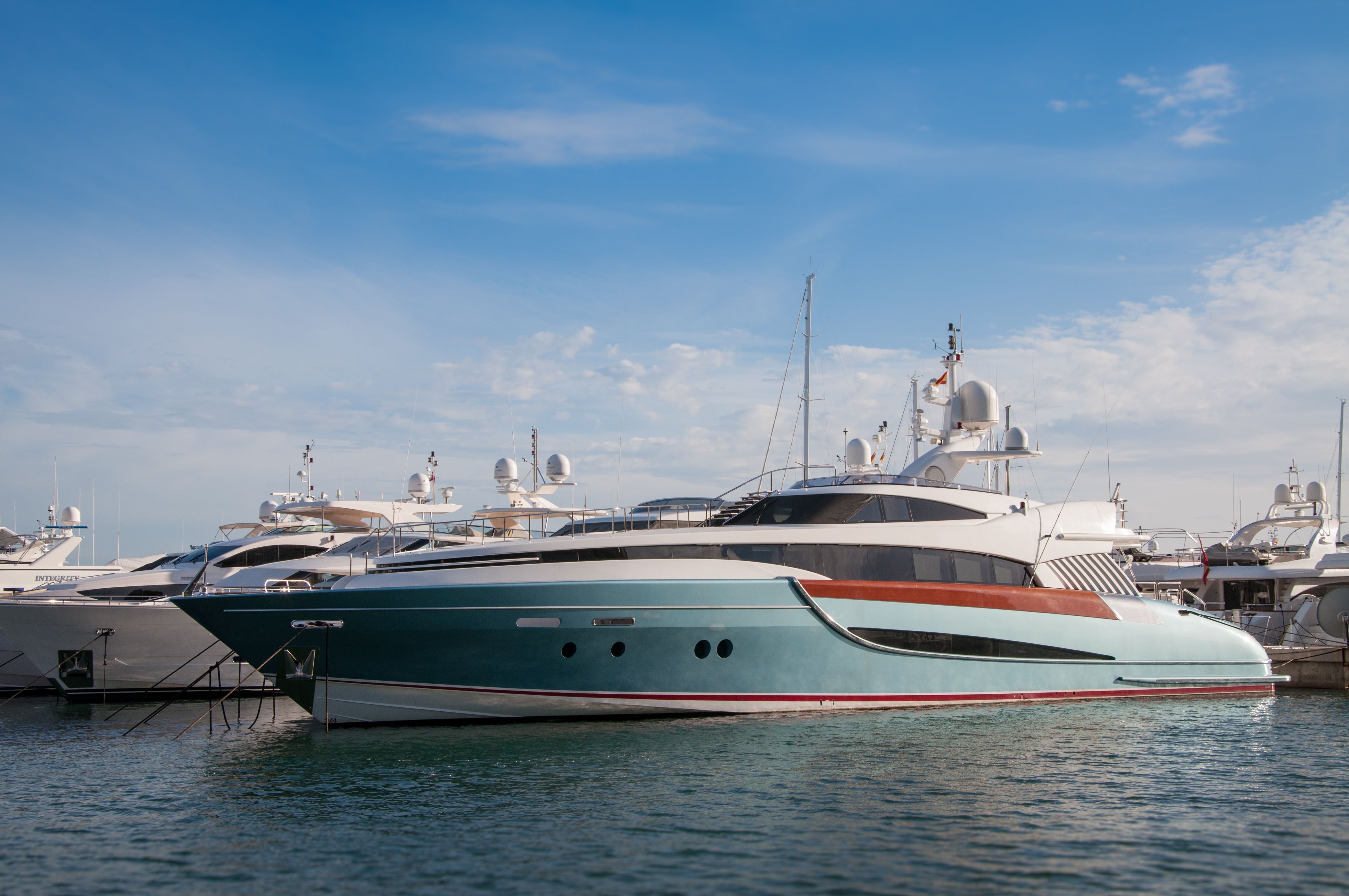
Most yachts change hands through brokerage: a central listing agent representing the seller. Brokerage is the most transparent route, because the listing market is public and comparable sales are traceable. It also means the broker's duty is to the seller, not to you, which is worth remembering when a listing sounds like a sales pitch.
Boat shows are excellent for understanding the market and terrible for making decisions. Use them to walk the boats, meet brokers, feel the difference between a 15-metre and an 18-metre hull, then make your decision on paper a week later.
Private sales can offer a better price because there is no commission, and a correspondingly higher risk because there is no professional on either side. If you buy privately, the survey becomes even more important, and the paperwork even more yours to verify.
Auctions and distress sales exist, mostly in the commercial and repossession end of the market. The prices look attractive until you price the works. Only pursue this route with a surveyor and a lawyer already engaged.
5. Choosing the right broker
There are two kinds: the seller's broker, who markets the boat, and the buyer's broker, who works for you. Most buyers use only the first and assume that is enough. On a boat above roughly €750,000, a buyer's broker who is paid a retainer or a modest success fee frequently pays for themselves in negotiation and in the survey findings they help you interpret.
Questions worth asking any broker you deal with:
- How long has the boat been listed, and at what price history?
- Why is the owner selling, and is the boat owned by a company or an individual?
- Has it ever been chartered commercially?
- What work has been done in the last three years, with invoices?
- Which yard maintains her, and can we speak to them?
A broker who answers these easily and honestly is worth working with. A broker who deflects them has told you something useful.
6. Reading a listing critically
A listing is a marketing document. The facts in it are usually true and frequently incomplete. Verify these in particular:
- Length: "length overall" and "length at waterline" are different numbers, and berthing and marina pricing use LOA. Confirm how the marina you want measures.
- Year: the model year and the launch year can differ by two or three. Ask for the hull identification number (HIN) and the delivery documentation.
- Engine hours: low hours on an old engine can be worse than high hours on a well-serviced one. Ask for the service log, not the number.
- Refit history: a 2008 boat with a 2019 refit may be a better buy than a 2015 boat that has never had a spanner on it. Ask what was actually replaced, and where.
- VAT status: the single most expensive ambiguity in European yachting. More on that below.
- Charter history: a commercially chartered boat has worked hard and been through more hands. That is not disqualifying, but it must be priced in.
When you are ready to compare boats side by side, use the marketplace search rather than a spreadsheet: the filters do the work of eliminating the boats your own criteria already ruled out.
7. Making an offer, and what the contract should say
The offer is where the process becomes contractual. Two documents matter.
A Memorandum of Agreement (MOA) sets out price, deposit, timetable, and, critically, the conditions under which you can walk away. The standard conditions buyers should insist on are: subject to satisfactory survey and sea trial, subject to clear title and no encumbrances, and subject to verification of VAT status for the jurisdiction you will keep the boat in.
The deposit (typically 10 per cent) should be held in a stakeholder or escrow account, not paid directly to the seller. The contract should state exactly what happens to it if the survey finds a defect: usually a right to renegotiate or to withdraw with the deposit returned in full.
Negotiating after the survey is normal and expected. Most experienced buyers use the survey findings, costed by a yard, as the basis for a price reduction rather than walking away, unless the findings are structural.
8. The survey and the sea trial
The pre-purchase survey is the most valuable money you will spend on the boat. On a mid-size yacht it is a modest four-figure sum that routinely saves five or six.
Commission:
- A full condition survey by a accredited surveyor, out of the water, with the hull cleaned so the bottom can be properly inspected.
- A mechanical survey of engines, generators, shafts, running gear and hydraulics, by a specialist, with oil and coolant analysis.
- A rig survey on sailing yachts, by a rigger, including a mast climb.
- Systems testing: electronics, navigation, air conditioning, watermakers, stabilisers, thrusters, tender and toys.
Then the sea trial, which is not a pleasant afternoon out. It is a test under load: full throttle, both engines, all systems running, at the speed and in the conditions the boat will really see. Insist on being aboard. Listen to everything.
Expect a survey report to list defects in three tiers: safety-critical, must-fix, and cosmetic. Price the first two with a yard before you negotiate. Do not accept a verbal reassurance in place of a written quote.
9. Title, VAT and registration
This is the part of buying a yacht where mistakes are expensive and permanent, and where a specialist maritime lawyer earns their fee.
- Title: confirm the seller owns the boat outright, that there is no mortgage or maritime lien against it, and that the entity selling is the entity that owns it. Ask for the builder's certificate, previous bills of sale, and registration documents.
- VAT: within the EU, a yacht's VAT status travels with the boat. A boat that has lost its VAT-paid status, or whose documentation cannot prove it, can face a substantial liability at the point of import or resale. Keep the original VAT invoice, the customs documents and the chain of ownership intact.
- Registration and flag: choose the flag state deliberately. It affects VAT and customs treatment, crewing requirements, and how the boat can be used commercially. Our VAT Calculator gives you the arithmetic of a purchase in the jurisdictions most buyers use, but the treatment itself is a question for a lawyer, not a calculator.
- LLC and company ownership: common, entirely legitimate, and worth understanding. If the seller is a company, the company's structure and liabilities come with the boat unless the deal is structured as an asset sale.
10. Paying for it
Most yacht purchases are cash, but finance is more common than the market admits, particularly at the upper end. Typical structures are a marine mortgage secured against the vessel, often 50 to 70 per cent of value, over five to fifteen years.
Lenders will want a survey, proof of insurance, and a documented ownership chain. Rates depend on the boat's age, the flag and your own financial profile. Finance is not a way to buy a boat you cannot afford to run: lenders themselves use running costs in their affordability assessment, for the same reason we suggest you do.
Before you buy, get a professional valuation as well as an estimate. If you want a starting point on where a specific model sits in the market, our Yacht Value Estimator gives you a data-informed range to argue with rather than a number to trust blindly.
11. Insurance, berth and the first season
Arrange insurance before completion, not after. Most marine insurers require a survey less than five years old, a specified cruising area, and a stated plan for where the boat will be kept during hurricane or winter season. Premiums vary enormously with flag, crew and experience, so get three quotes.
Secure the berth before you commit to the boat if you can. In the Mediterranean, a permanent berth in a good marina can be worth more than a discount on the hull, and waiting lists in the most popular ports run into years.
Then plan the first season modestly. A shakedown cruise near a yard, with the previous owner's maintenance contacts to hand, is worth more than a long delivery to a distant paradise with an unfamiliar boat.
12. The mistakes that cost the most
- Skipping the survey because the boat looks immaculate. Clean gelcoat sells boats. It also hides moisture, poor repairs and tired systems.
- Buying at the top of the size you can afford. Costs scale faster than length. Buy the boat you can run well.
- Ignoring VAT and title until the paperwork stage. By then you have negotiating leverage of zero.
- Falling for a refit without invoices. A refit is a set of documented works, not a claim in a listing.
- Forgetting the tender, toys and crew in the budget. These are often the difference between a boat used forty days a year and one used ten.
- Buying without a sea trial in real conditions. Everything works at the dock.
The checklist before you sign
- Use case defined and written down.
- Five-year budget modelled, including running costs and depreciation.
- Berth secured or shortlisted.
- Insurance quoted.
- Broker instructed and conflicts of interest understood.
- MOA reviewed by a lawyer, with survey and title conditions explicit.
- Deposit held in escrow.
- Hull, mechanical, rig and systems surveys commissioned.
- Sea trial completed under load, with you aboard.
- Title, liens, VAT status and registration verified in writing.
- Defects costed by a yard and reflected in the final price.
- Delivery, handover and crew plan agreed.
Where to go next
A well-bought yacht is the beginning of decades of use, not the end of a transaction. If you are ready to start looking, browse the yachts currently for sale and use the filters to match the criteria you wrote down at the start. If you are selling, list your yacht and put it in front of buyers who are looking with exactly this process in mind.
And if you are still three months from a decision, the calculators are the most useful thing on this site: run the running costs, the cost of ownership and the value estimator on the boat you are considering, and see whether the numbers still make sense on a Tuesday morning in November. That is the test that matters.