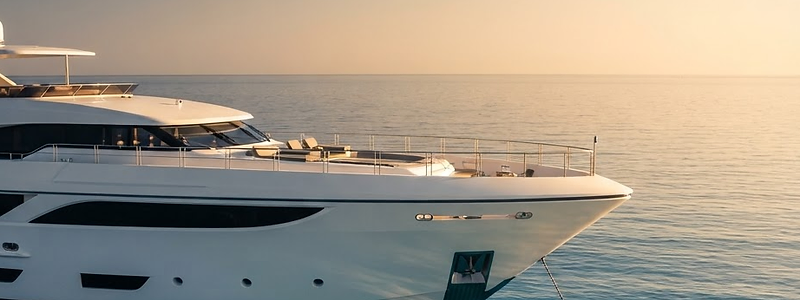
Ask a sailor whether you should buy a motor yacht and you will get a lecture about the smell of diesel and the sound of an anchor winch. Ask a motor yacht owner whether you should buy a sailing yacht and you will hear about the day the wind died off Cap Ferrat with guests waiting for lunch. Both are describing their own summer, not yours.
The honest answer is that these are two different products that happen to share the water. One sells certainty. The other sells the passage itself. Choosing between them is not a question of seamanship, taste or budget alone, but of a smaller and far more practical thing: the version of boating you will genuinely do twenty weekends a year, in the water where your boat actually lives.
Here is how the decision really breaks down.
Two ideas of a day at sea
A motor yacht is a scheduling machine. You leave at nine and you are anchored off the next bay by half past ten, regardless of what the wind is doing. Guests arrive, the tender goes down, lunch is served, and by four o'clock you are back on the berth with the covers on. For anyone whose time on board is measured in short, precious blocks, that reliability is the entire point.
A sailing yacht is a travelling machine. The day is shaped by the wind, the passage is part of the pleasure, and arriving somewhere under sail still feels like an achievement the fourth time you do it. What you gain in texture you lose in predictability. A thirty mile hop that a motor yacht covers in ninety minutes can be a five hour beat to windward, or an afternoon of motoring in a flat calm.
Neither description is a disadvantage. They are simply different definitions of a good day.
Start with the water, not the boat
The single most useful filter is where the yacht will be kept.
In the Mediterranean, summer wind is often either absent in the morning or brisk in the afternoon, distances between interesting anchorages are short, and the water is warm enough that the journey matters less than the destination. That is friendly territory for either type, and it is why both markets are so strong there.
In northern Europe the calculation changes. Tidal gates, cold water, unsettled weather and longer hops to anywhere worth going all reward speed and shelter. A motor yacht lets you take advantage of a four hour weather window that a sailing yacht would have to sit out. Conversely, in the trade wind belts, a sailing yacht gives you free miles, steady breeze and a motion that is easier on the stomach than a planing hull pushing into a swell.
If you do not yet know where the boat will live for the next five years, stop here. Every other consideration is downstream of that one.
The passage problem: range, speed and autonomy
The technical divide is easiest to see in passage planning.
A typical cruising sailing yacht of 45 to 55 feet makes good 7 to 9 knots under sail in a decent breeze, and perhaps 7 knots under engine. Under power alone it will burn somewhere between four and ten litres an hour at cruising rpm, which is why a sailing yacht with a full tank can motor for several hundred miles if it has to.
A planing motor yacht of similar length will cruise at 18 to 25 knots and burn an order of magnitude more fuel doing it. Range at speed is often 250 to 400 nautical miles, which is plenty for coastal cruising and entirely inadequate for anything more ambitious. Long range displacement motor yachts solve this with bigger tanks and slower hull speeds, trading 20 knots for 10 and a range measured in thousands of miles.
So the question becomes: do you want to cover 200 miles in a day, or do you want to cover 1,000 miles without refuelling? Very few owners need the second, and those who do usually already know it. Most coastal owners need the first and underestimate how much they will use it.
What you get for the same length
A motor yacht wins on volume, and it is not close. The hull is wide and full, the accommodation can run the full beam, the galley often sits up on the main deck where the view is, and there is usually a flybridge, a tender garage and a hydraulic bathing platform.
A sailing yacht is narrow by necessity. A hull that has to heel and drive through water efficiently cannot also be a wide apartment, and the rig takes up space above that the motor yacht uses for a sun deck. What you get instead is a deep, secure cockpit, a long working deck, better ventilation, and a layout designed around the motion of the boat rather than the size of the cabin.
The practical consequence is that a 50 foot motor yacht can feel like a small apartment for six, while a 50 foot sailing yacht feels like a well organised boat for four. If your priority is entertaining a crowd at anchor, the motor yacht is the more efficient use of the same length, and therefore the same berthing invoice.
Heel, motion and the people you bring
Sailing means heeling. Ten to twenty degrees of it is normal, and for many people it is the most beautiful thing about the boat. For a nervous guest, a small child or a grandparent with balance problems, it is the reason they stay ashore next time.
Motor yachts are not automatically comfortable. A light planing hull at anchor in a swell rolls quickly and uncomfortably unless it has stabilisers, and stabilisers are a significant cost to buy, run and maintain. A sailing yacht at anchor sits behind its mast and tends to lie more quietly, though it will still roll in the wrong conditions.
If the boat is primarily a platform for other people's enjoyment, the honest test is not the sea state on a good day but the reaction of your least confident regular guest on an average one.
Crew: the quiet dividing line
A sailing yacht of 45 to 55 feet can absolutely be run by an experienced couple, and much of the joy of ownership is in exactly that self-sufficiency. It does mean work: sail handling, reefing, mooring, maintenance of rig and running gear. The learning curve is real, but it is finite, and it makes the boat yours in a way a motor yacht rarely does.
A motor yacht is easier to operate. Docking is more predictable, systems are more automated, and a couple can manage a 50 to 60 foot boat without much drama. Above roughly 24 metres, though, expectations of service rise, and a captain, engineer and stewardess become normal rather than indulgent. Crew is the largest single line in a large yacht's budget and it arrives far earlier on the motor side, because guests on a motor yacht expect hotel standards on a boat that can carry them.
Running costs: what actually dominates the annual bill
Owners consistently overestimate fuel and underestimate everything else.
On a sailing yacht, fuel is a rounding error. Against it sits a rig: standing rigging has a finite life of roughly a decade or so, a cruising wardrobe of sails costs a meaningful five figure sum to replace, and both need inspection and occasional repair. Sailing gear wears in ways that engines do not.
On a motor yacht, fuel becomes significant the moment you use the throttles, but even there it is usually not the largest number. Berthing by length, insurance, maintenance, tender servicing, antifouling, polishing, covers and teak all scale with the boat rather than with the fuel. Engine servicing on two large diesels is routine and expensive, and it happens whether you go anywhere or not.
The shape of the two cost profiles is different, which matters more than the total. A sailing yacht's costs are lumpier and more predictable: long quiet periods punctuated by rigging, sails and canvas. A motor yacht's costs are smoother but respond directly to use, so a heavy season is visibly more expensive than a light one.
Both types reward a proper ten year model rather than a one year guess. Our cost of ownership calculator and running cost calculator will give you a realistic annual picture once you have the quotes in hand.
Depreciation and what the market does next
Neither type is an investment, but they behave differently on the way down.
Production motor yachts are built in volume, which is good for buyers and less good for sellers. The first three to five years carry the steepest fall, and a well specified 15 year old motor yacht competes directly against a large pool of similar boats.
Sailing yachts are a smaller market with a more committed buyer. Blue chip sailing brands with strong offshore reputations have a loyal following and can hold value remarkably well for their age, while ordinary production cruisers depreciate in the same unremarkable way as anything else. The catch is liquidity: fewer buyers means longer to sell, and condition and equipment matter more.
If resale within three years is part of the plan, buy the boat the local market understands. If you intend to keep it a decade, buy the boat you will actually use.
Charter, if revenue is part of the reasoning
Charter demand splits along the same lines as ownership.
In the Mediterranean, skippered sailing yachts are the backbone of the bareboat-adjacent market: families and groups who want a week, a skipper and a route, at a price that still looks reasonable when split eight ways. Motor yachts dominate the day charter, event and short break market, where the product is speed, space and service rather than the sailing itself.
If you are considering charter to offset costs, model it honestly. A charter week is not the same as an owner week, and a commercially coded boat carries extra crew, insurance and compliance costs that quietly erase the apparent income. Our charter cost calculator is a reasonable place to start.
The environmental question is becoming a practical one
Regulation, marina policy and social expectation are all moving in the same direction. Fuel consumption at 20 knots is increasingly difficult to defend, both financially and in conversation. Hybrid propulsion, larger battery banks and genuinely usable solar are arriving first on sailing yachts, where the rig already does most of the work, and gradually on displacement motor yachts.
None of this makes a motor yacht a bad purchase today. It does mean that the resale market of the 2030s will look more kindly on efficiency than the market of the 2010s did, which is worth ten minutes of thought before you sign.
A short decision framework
Answer these seven questions without flattering yourself.
Where will the boat live? If the answer is a windless summer sea with short hops, either works. If it is a cold, tidal, weather-driven coast, speed is a genuine safety feature.
What does a normal weekend look like? Anchored in one bay with eight friends, or a passage to somewhere new with two or three?
Who is usually on board? If the answer includes people who are uncomfortable with heel, the romance of sailing will cost you your crew.
Will you have paid crew? Sailing keeps the self-sufficient option open for longer. Motor yachts pull you towards professional crew sooner.
How many nights a year will you sleep aboard? Volume matters far more on a boat used as a floating apartment than on one used as a day boat.
Do you actually want to sail, or do you want to have sailed? The difference is roughly two hundred days of learning. Both are legitimate reasons, but only one survives contact with a windy Tuesday.
What ten year cost will you genuinely carry? Not the purchase price, the annual reality.
The honest answer
Buy a sailing yacht if the passage is the point, if you want to spend months rather than weekends aboard, if autonomy from fuel docks appeals to you, and if you are willing to learn a boat that asks something of you. Accept the heel, the narrower cabins and the rigging invoices as the price of the thing you actually wanted.
Buy a motor yacht if time is your scarcest resource, if your guests are the reason for the boat, if your coast is weather driven, and if you would rather arrive than travel. Accept the fuel, the volume-driven depreciation and the earlier arrival of crew as the price of certainty.
What you should not do is buy one and pretend it is the other. The most expensive yacht is the one bought for the idea of a lifestyle that never quite gets used, and the best one is whichever type you take out on a grey Sunday in October because you want to, not because you feel you should.