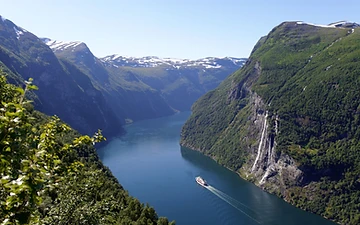
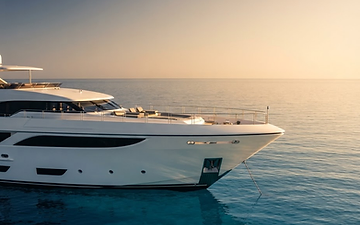
There is a moment on every high-latitude voyage when the map stops being a map. The coastline dissolves into a rumour of rock and ice, the horizon loses its edge, and the only reliable instrument is a crew that has done this before. For families who have cruised the Mediterranean, the Caribbean and the Balearics, Greenland and Arctic Canada are the next great step: a theatre of ice, light and silence that no temperate cruising ground can imitate.
This is not a destination you add to an itinerary. It is a destination you prepare a yacht, a crew and a family for. Here is what that preparation looks like.
Two Destinations, One Vast Theatre
Greenland and Arctic Canada sit on opposite shores of Baffin Bay, separated by roughly 500 nautical miles of open water and joined by the same ice, the same weather systems and the same short summer.
Greenland: ice in every form it takes
Greenland is the largest island on earth and almost entirely ice. The inhabited edges are a thin, extraordinary ribbon of fjord, mountain and settlement, and the cruising is built around three distinct regions.
Disko Bay, midway up the west coast, is the classic introduction. The UNESCO-listed Ilulissat Icefjord carries icebergs from Sermeq Kujalleq, one of the most productive glaciers in the northern hemisphere, into a bay so densely packed that navigating it is an act of patience rather than speed. Towns such as Ilulissat and Qeqertarsuaq give families a first taste of Greenlandic life, and the coastline north to Uummannaq adds some of the most dramatic mountain scenery anywhere in the Arctic.
South Greenland is greener, gentler and warmer, with Norse ruins, sheep farms and hot springs. Prince Christian Sound, the narrow passage that cuts through the southern tip, is a transit highlight: sheer walls, waterfalls dropping directly into the water, and floating ice that requires a proper watch.
Scoresby Sund, on the east coast, is the other extreme. It is one of the largest fjord systems in the world, reachable in most seasons only through a band of drifting sea ice. Those who make the passage find icebergs measured in kilometres, abandoned Inuit settlements, and a scale that resets every expectation. Visit Greenland maintains practical regional information and seasonal guidance worth reading before you plan.
Arctic Canada: the deep north
Crossing to Canada means leaving the relative infrastructure of Greenland behind. Baffin Bay leads to Lancaster Sound and Tallurutiup Imanga, a national marine conservation area of around 108,000 square kilometres that is one of the richest marine habitats in the Arctic and a cornerstone of Inuit food security.
Baffin Island's east coast offers fjords to rival Greenland's, with the granite walls of Auyuittuq and the bird cliffs and glaciers of Sirmilik National Park at Bylot Island. Further north, Devon Island, Beechey Island and the channels of the Canadian Arctic Archipelago carry the history of nineteenth-century exploration in a landscape with no permanent human population at all. Nunavut Tourism is the best starting point for understanding community access and Inuit cultural protocols.
A full transit of the Northwest Passage is the headline achievement, and it should be treated as an ambition rather than a promise. Many seasons open the route; some do not. Build a plan that is satisfying whether or not the ice allows the through-passage.
When to Go, and Why the Window Is Narrow
The Arctic summer is short and unforgiving of optimistic scheduling. Broadly, the useful window runs from June to early September in Greenland and from July to early September in Arctic Canada, when the sea ice retreats and the light never fully leaves the sky. Midnight sun from late May to late July makes long passages easy and gives photographers the flattering low light that Arctic imagery depends on.
August and early September bring more mobile wildlife and the first autumn colour, with a higher chance of weather disruptions. June offers cleaner ice and quieter anchorages but colder water and fewer landing opportunities on land still snowbound. Whatever the month, build slack into the itinerary: in these latitudes, weather is not a delay to be resented but a condition to be designed around.
What a Yacht Actually Needs
The difference between a yacht that can visit the Arctic and a yacht that should is rarely about luxury. It is about structure, redundancy and range.
Hull, class and ice capability
Look for a genuinely ice-strengthened hull, not merely a high-latitude aesthetic. Expedition yachts typically carry an IACS Polar Class notation in the PC6 or PC7 range, or a classification society ice class such as 1A or 1B, combined with a steel or heavily framed aluminium hull and a reinforced bow. Builders such as Damen Yachting have made this the centre of their expedition programmes, and older commercial hulls converted by yards such as Pendennis offer another route to genuine capability.
Class alone is not enough. Ask how the yacht has actually been used, and expect to see the ice transit history, the survey record and the classification documents.
Range, fuel and self-sufficiency
Distances here are measured in weeks, not hours. A yacht cruising Greenland and Arctic Canada should be comfortable with long legs between fuel stops, with several thousand nautical miles of range as a working minimum for anything involving Baffin Bay crossings and extended fjord exploration. Fuel quality and filtration matter as much as capacity, and a fuel-polishing regime is not optional.
Equally important is what the yacht can make for itself: fresh water from a reliable watermaker, waste handling that meets Arctic discharge rules, spare parts that cannot be flown in, and a freezer and dry store sized for a family plus crew for a month.
Systems that keep a family comfortable
Arctic cruising is cold, wet and often rolling. Heated decks, a proper drying room, an enclosed and heated tender garage, and genuinely warm crew and guest areas turn an endurance test into a holiday. Stabilisation at anchor matters more than most owners expect, because the best evenings are spent stationary in a silent fjord rather than under way.
Tenders, toys and access
Almost everything worth seeing in the Arctic is ashore or at the waterline. Two capable RIBs, redundancy in outboards, kayaks, dry suits and a tender that can be launched in a swell are the difference between a voyage of observation and a voyage of participation. A helicopter or a drone extends reach and perspective considerably, subject to local permissions.
Communications and redundancy
Satellite communications have improved enormously, but the Arctic still punishes single points of failure. Dual VSAT and LEO satellite systems, an Iridium backup, paper and electronic charts with noted survey limitations, and a crew trained for independence are baseline expectations. Search and rescue response times in these regions are measured in days.
A Day Aboard in the Ice
The rhythm of an Arctic day is set by ice and light rather than by clocks. A morning might begin with a RIB landing on a beach where the only footprints belong to musk oxen, followed by a glacier transit in the afternoon and an anchorage chosen for shelter rather than scenery. In Greenland's Disko Bay, an evening might be spent drifting quietly past icebergs that glow from within at midnight. In Arctic Canada, the same hours may be spent watching narwhal and bowhead from a respectful distance, or listening to a guide explain the significance of a site that has been used for thousands of years.
Wildlife encounters are the reason many families come: whales, walrus, seals, polar bears, arctic fox and vast seabird colonies. They are also the reason the rules exist. Polar bears are not a photographic opportunity to be managed casually; they are the apex predator of the region, and every landing is planned accordingly.
Cruising With Children
Families who take children north almost always describe it as the most formative trip they have made together. The Arctic teaches patience, observation and humility in a way that no Mediterranean itinerary can.
That said, a few practical considerations matter. Choose a yacht with genuinely separate cabins and a crew comfortable with children. Plan shorter legs and more anchorages than an adult-only programme would need. Bring layers that can be dried, not merely packed. And consider the educational dimension deliberately: a good expedition crew will weave glaciology, Inuit history and marine biology into the days without turning the voyage into a lecture.
For teenagers, the Arctic offers something increasingly rare: a place where competence, not connectivity, is the currency. Many families find that the lack of signal becomes a feature rather than a hardship.
Safety, Permits and the Rules of the North
The regulatory framework around polar cruising is not decorative. The IMO Polar Code, in force since 2017, sets requirements for ship structure, equipment, training and operational planning for vessels operating in polar waters, and any yacht operating commercially in these regions should be able to demonstrate compliance.
In Canada, entry into national parks and marine conservation areas requires permits, and travel in Inuit-owned and community-adjacent areas carries responsibilities beyond paperwork. In Greenland, cruising permits, waste and fuel rules, and access to protected areas are administered locally, and requirements change. The Association of Arctic Expedition Cruise Operators publishes operational guidelines that have become the de facto standard for responsible Arctic voyaging, including site-specific guidance on landings, wildlife distances and community engagement.
Ice information is a planning input rather than a background detail. The Danish Meteorological Institute publishes ice charts covering Greenlandic waters that should be consulted daily in season, and the Arctic Council's working groups provide a broader picture of changing conditions. Season-on-season variability is significant, and the NOAA Arctic Report Card is a useful annual reminder of how quickly the environment is shifting.
Insurance deserves early attention. Polar and high-latitude cover is often excluded by default and must be negotiated explicitly, with conditions tied to ice class, season and crew experience.
Travelling Lightly
The Arctic is one of the least resilient environments on earth and one of the most closely monitored. Black carbon from exhaust settles on ice and accelerates melt; anchoring in unconsented locations can damage benthic communities that take decades to recover; approaching wildlife too closely causes stress that is invisible to the observer.
The responsible approach is well established. Use cleaner fuels and modern engines where possible, avoid unnecessary idling, treat wastewater properly, carry and use approved landing protocols, keep the distances AECO recommends, and engage with communities before arriving rather than after. PAME, the Arctic Council's marine environment working group, is a good source for the policy context behind these practices.
Practical Planning
Realistic preparation for a first Arctic season takes twelve to eighteen months. Crew selection is the single most important decision: experienced ice navigators and expedition leaders are a small community, and the best of them are booked well ahead. Provisioning, insurance, permits and spare parts all require lead times that temperate cruising never demands.
Budget expectations vary enormously with the platform. A charter of a capable expedition yacht in Greenland or Arctic Canada typically runs into six figures for a multi-week programme once fuel, crew, permits and repositioning are included, while owning the right yacht and operating it north of the circle means accepting a substantial annual commitment for a short season.
For families, the honest calculation is not cost per day but value per experience. There is no cheaper way to see the Ilulissat Icefjord under midnight sun from your own aft deck, and no substitute for the moment a child realises the white shape in the distance is not a boat.
Where to Begin
Start with capability, not itinerary. Identify yachts with genuine ice class, verified high-latitude history and crews who have operated in these waters, then build a route around the season rather than forcing a season around a route. Browse the expedition-capable listings on YachtCrest, speak to brokers who have arranged Arctic programmes before, and treat the first season as an apprenticeship in a place that rewards respect above ambition.
Polar itineraries require experienced professional crews and current local, regulatory and ice-condition advice. Conditions change season to season, and any voyage plan should be confirmed with qualified ice navigators and the relevant authorities before departure.